Courses
Environmental Laborers Training
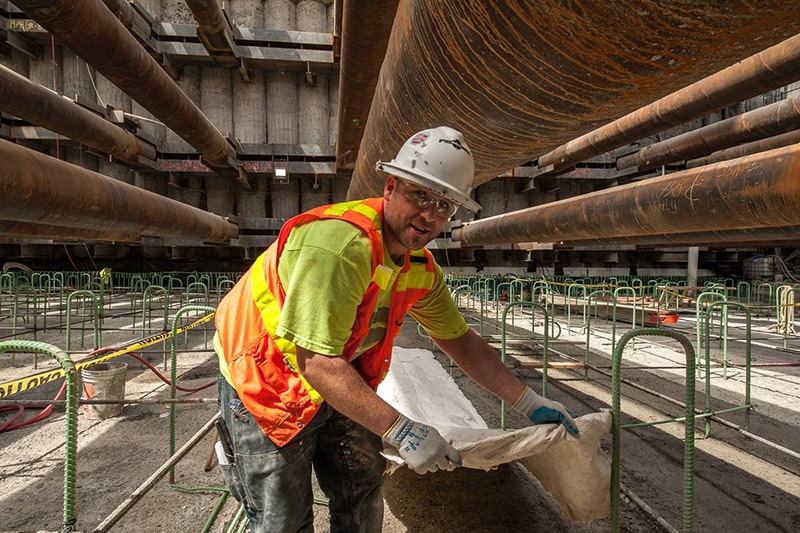

Environmental remediation is the rectification of hazardous substances by removing, treating, and containing pollution or contaminants from environmental media like soil, groundwater, sediment, building materials, paint, coatings and adhesives. This process is crucial for protecting the environment and public health by reducing the presence of harmful substances. Remediation can involve various methods categorized as ex-situ (extraction and removal of contamination) or in-situ (treating contamination without removing soils or groundwater). The latter is the preferred method whenever possible. Environmental remediation specialists are vital in addressing contamination caused by industries like oil and gas production, chemicals production, groundwater contamination, soil contamination, air pollution, and hazardous waste management. The process typically includes initial site assessment, investigation, remediation plan development, implementation, final validation, and long-term monitoring. Various technologies such as solidification and stabilization, soil vapor extraction, bioremediation, chemical oxidation and others are used for remediation.
Check out the following course descriptions below to get an idea of what you’ll learn as a Construction Craft Laborer engaged in remediation work:
What is Asbestos?
Asbestos is a mineral that is found throughout the world. When asbestos is mined and processed, it easily separates into long flexible fibers. These Fibers are very good for use as a non-combustible, non-conducting or chemically resistant material. Asbestos fibers do not burn, break down, conduct electricity or decompose. Because of its durability, they were once widely used in consumer products, from oven mitts to building insulation and materials. However, in the 1970s, it was discovered that exposure to asbestos can cause serious cancers and other diseases such as mesothelioma and asbestosis.
While asbestos is now heavily regulated in the U.S., it’s still possible to find asbestos in older homes and buildings. The vast majority of asbestos in buildings is chrysotile. This kind of asbestos is commonly found in roofs, ceilings and walls. Much of the asbestos found in floor tiles is also chrysotile. It has also been used in car parts such as brake linings, gaskets and boiler seals and as an insulation for pipes, ducts and appliances. There are two main families of asbestos: serpentine and amphibole. Chrysotile falls under the category of serpentine, which is characterized by a curly, layered structure. Its flexible but durable properties are some of the reasons for chrysotile’s popularity as well as the fact that it is naturally resistant to heat and fire.
Asbestos has some distinguishable features, and an analysis of its appearance often requires the help of a microscope to show its color and shape. This is because asbestos can break down into such small particles that its fibers can’t be seen by the naked eye. Asbestos is only visible if it is in groups or clumps; otherwise, the individual fibers are too small to see without a microscope.
Laborers trained in asbestos remediation shall comply with the following standard. The OSHA Asbestos Standards for Construction, 29 CFR 1926.1101, requires a competent person on all asbestos jobs. 29 CRF 1926.1101(b) basically defines a competent person as: (In addition to the definition in 2926.32(f)) One who is capable of identifying existing asbestos hazards in the workplace and selecting the appropriate control strategy for asbestos exposure, who has the authority to take prompt corrective measures to eliminate them. In addition, for Class I and Class II work, who is specially trained in a training course which meets the criteria of the EPA’s Model Accreditation Plan (MAP) (40 CFR part 763) for supervisor, or its equivalent, and for Class III and Class IV work, who is trained in a manner consistent with EPA requirements for training of local education agency maintenance and custodial staff as set forth at 40 CFR 763.92(a)(2).
A History of Lead and its Hazards.
Lead (Pb), a soft, silvery white or grayish metal in Group 14 (IVa) of the periodic table. Lead is very malleable, ductile and dense. Known in antiquity and believed by the alchemists to be the oldest of metals, lead is highly durable and resistant to corrosion. Even the ancient Romans used lead to make water pipes.
Lead and its compounds are toxic and are retained by the body, accumulating over a long period of time—a phenomenon known as cumulative poisoning—until a lethal quantity is reached. The toxicity of lead compounds increases as their solubility increases. In children the accumulation of lead may result in cognitive deficits; in adults it may produce progressive renal disease. Symptoms of lead poisoning include abdominal pain and diarrhea followed by constipation, nausea, vomiting, dizziness, headache, and general weakness. Elimination of contact with a lead source is normally sufficient to effect a cure. The elimination of lead from insecticides and paint pigments and the use of respirators and other protective devices in areas of exposure have reduced lead poisoning materially.
Lead has many other applications, the largest of which is in the manufacture of storage batteries. It is used in ammunition (shot and bullets) and as a constituent of solder, type metal, bearing alloys, fusible alloys, and pewter. In heavy and industrial machinery, sheets and other parts made from lead compounds may be used to dampen noise and vibration. Because lead effectively absorbs electromagnetic radiation of short wavelengths, it is used as a protective shielding around nuclear reactors, particle accelerators, X-ray equipment, and containers used for transporting and storing radioactive materials. Together with the compound lead oxide (PbO2) and with lead-antimony or lead-calcium alloys, it is employed in common lead acid storage batteries.
What was the purpose of adding lead to paints?
Different lead compounds are added to the paint as a pigment, creating a specific color depending on whichever compound is used. For example, lead (II) carbonate, known as white lead, makes the paint a white or cream color and the use of lead tetroxide makes a bright red paint. The heavy metal additive also decreases the amount of time that the paint takes to dry, makes the paint more durable, and causes the paint to be more moisture resistant.
The United States banned the manufacture of lead-based paint in 1978. However, it can still be used in houses and buildings, but the government requires that the lead content be less than 90 parts per million. The major source of exposure to lead-based paint in the United States continues to be in homes and buildings built before 1978. lead paint that appears intact is not necessarily harmful. Lead-based paint can produce dangerous lead dust if the paint has been damaged, such as if it is peeling, flaking, being rubbed or disturbed in some manner. For this reason, and particularly on building renovation projects, Laborers are trained and certified in the proper methods to safely remove and contain lead-based paint hazards.
Why was lead an additive in gasoline?
In 1923, tetraethyl lead was added to gasoline to increase the octane rating and prevent premature combustion which caused the characteristic “knock” in gasoline engines.
As the environmental movement gained momentum throughout the 1960s, increasing scrutiny was placed on air quality and the deleterious effects of lead pollution on humans—particularly in cities plagued by smog, such as Los Angeles. That attention, combined with passage of the Clean Air Act of 1963, the creation of strong federal regulatory agencies (e.g., the Environmental Protection Agency in 1970), and shifting scientific consensus on the dangers of lead, posed a considerable threat to the continuing use of leaded gasoline.
In 1986, the EPA mandated a reduction of tetraethyl lead concentrations in gasoline from 1.1 g/gal to 0.1 g/gal. Leaded gasoline was completely banned in the United States in 1996 and in the European Union in 2000. Leaded gasoline remained available in a number of countries well into the 21st century but is no longer available for on-road use since 2021.
Spray-Applied Fireproofing
Fireproofing stands as an essential factor in developing and sustaining commercial buildings. Fire protection plays a fundamental role in life saving and business continuityto stay operational through compliance with regulations and reducing property damage in emergencies.
The primary goal of commercial fireproofing is to delay structural failure, which ensures evacuation routes remain accessible for a prescribed amount of time, usually between 1-4 hours.
When exposed to high heat, structural steel can lose up to half of its strength and begin to buckle or collapse around 1,000°F. Fireproofing materials act as a thermal barrier, keeping the temperature of the steel below this critical level, making the structure sound even in emergencies.
To ensure safety, commercial buildings must meet stringent fire-resistance ratings (FRR) set by local and national codes, such as those governed by the International Building Code (IBC) and the National Fire Protection Association (NFPA).
Spray-applied fireproofing has many advantages, such as ease of application, and versatility. Cementitious coatings can be applied quickly and evenly over a wide variety of surfaces: steel beams and columns, concrete structures, and wood frames. Spray coatings also tend to be cost-effective, particularly for large-scale applications or when fireproofing improvements need to be made to an existing structure.
Hazardous Waste Operations
Hazardous Waste refers to any solid, liquid, or gaseous material that, because of its quantity, concentration, or physical or chemical characteristics, poses significant potential hazards to human health and the environment when improperly treated, stored, transported, disposed of, or otherwise managed.
Hazardous waste can be defined based on the following characteristics:
- Ignitability: Substances that can readily catch fire under standard temperature and pressure conditions.
- Corrosivity: Materials that can corrode metals or have a very high or low pH.
- Reactivity: Substances that can cause explosions, toxic fumes, gases, or vapors when heated, compressed, or mixed with water.
- Toxicity: Materials harmful or fatal when ingested, inhaled, or absorbed by the skin.
An unexpected release of hazardous substances, or a substantial threat of a hazardous substance release, can pose a significant health and safety risk to workers. Unexpected releases can be caused by operation failures and unrelated outside events (e.g., natural disasters, terrorism). Workers can encounter hazardous substances through waste dumped in the environment—a serious safety and health issue that continues to endanger life and environmental quality. Employers must adequately prepare emergency response and cleanup workers to clearly understand their role(s) in managing unexpected releases of hazardous substances, so that they can act quickly and respond in a safe manner during an emergency.
The Superfund Amendments Reauthorization Act (SARA) of 1986 required OSHA to issue regulations protecting workers engaged in hazardous waste operations. OSHA’s Hazardous Waste Operations and Emergency Response (HAZWOPER) standards (in general industry, 29 CFR 1910.120; and construction 29 CFR 1926.65) established health and safety requirements for employers engaged in these operations, as well as responses to emergencies involving releases of hazardous substances. HAZWOPER requires that employers follow specific work policies, practices, and procedures to protect their workers potentially exposed to hazardous substances. The standards provide employers with the information and training criteria necessary to ensure workplace health and safety during hazardous waste, emergency response, and cleanup operations involving hazardous substances. HAZWOPER aims to prevent and minimize the possibility of worker injury and illness resulting from potential exposures to hazardous substances.